Our Alliance Tournaments (USA Dream Open, World Sport Elite Open, Bay Area Open, and Blue Dragon Open) are dedicated to providing a high-quality competition experience, helping athletes prepare for State Championships and reach the next level of their journey. To better serve our participants, we continuously update specific rules for Mixed Pair and Team Poomsae based on local conditions and requirements.
QUESTION: Is a 2nd Dan athlete allowed to perform 1st Dan Poomsae in competition?
Poomsae Regulations for Black Belt Competitions
In official Black Belt divisions, the competition is categorized by the participant’s current Dan (Rank). Unlike color belt divisions where multiple forms might be allowed, Black Belt competitors are required to perform the Poomsae assigned to their specific degree.
1. The “One Dan, One Poomsae” Rule
Competitors must master and perform the Poomsae that represents their current level of authority and skill. In most tournament structures, a participant is only permitted to perform the Poomsae of their own Dan.
2. Designated Poomsae by Rank
The following table outlines the mandatory Poomsae for each Black Belt division:
| Division | Assigned Poomsae |
| 1st Dan | Koryo (고려) |
| 2nd Dan | Keumgang (금강) |
| 3rd Dan | Taebaek (태백) |
| 4th Dan | Pyongwon (평원) |
| 5th Dan | Sipjin (십진) |
| 6th Dan | Jitae (지태) |
| 7th Dan | Chonkwon (천권) |
| 8th Dan | Hansu (한수) |
| 9th Dan | Ilyeo (일여) |
3. Key Competition Rules
- Division Separation: Competitions are strictly divided by Dan. A 2nd Dan student will never compete against a 1st Dan student in the same bracket.
- Restricted Performance: A 2nd Dan competitor is not allowed to perform Koryo (1st Dan) or Taebaek (3rd Dan) in their specific 2nd Dan division match. They must perform Keumgang.
- Judgment Criteria: Judges look for the specific characteristics of that Dan’s Poomsae. For example, in the 2nd Dan division, the focus is on the balance and stability required for Keumgang.
QUESTION: Which Taegeuk Poomsae (Color Belts) should I perform for the competition?
Athletes must select and perform one (1) Poomsae from the specific Taegeuk forms assigned to their current belt level:
-
White / Yellow / Orange Belts: Taegeuk 1 or 2.
-
Purple / Green / Blue Belts: Taegeuk 3, 4, 5, or 6.
-
Brown / Red Belts: Taegeuk 7, or 8.
Competition Rule:
-
You may select one Poomsae to perform from the list assigned to your specific belt level.
QUESTION: How many Team Form divisions are there, and what are the rules?
There are two (2) categories available for the Team divisions:
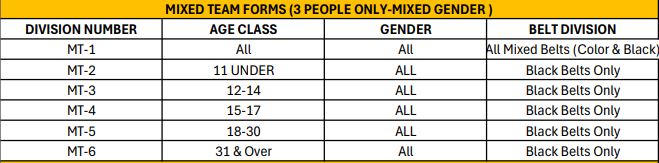
1. Mixed Belts Team Division
- Gender: No restrictions. Any combination is allowed (e.g., 2 Males/1 Female, 3 Females, or 3 Males).
- Age & Rank: Open to all ages. Partners do not need to be in the same age group or hold the same belt level (Mixed ranks allowed). Color belts may team up with black belts.
- Poomsae: The team must perform a Taegeuk Poomsae (Color Belt Poomsae).
2. Black Belt Team Division
-
Gender: There are no restrictions on gender. Mixed gender teams are permitted and encouraged.
-
Age & Rank: As shown in the table above, the Mixed Team divisions for Black Belts are organized into six distinct categories based on the age of the competitors.
-
MT-1: Open to all ages and mixed ranks (Color & Black Belts).
-
MT-2 through MT-6: These divisions are strictly for Black Belts only and are divided by specific age brackets.
-
-
Poomsae: Each team must perform one Black Belt Poomsae of their choice.
QUESTION: How many Mixed Pair Form divisions are there, and what are the rules?
Poomsae Pair Divisions
There are two (2) categories available for the Pair divisions:
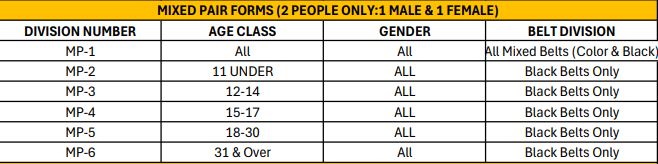
1. Mixed Belts Division
- Eligibility: A female Color Belt athlete may pair with either a male Color Belt or a male Black Belt. Or a male Color Belt athlete may pair with a female Color Belt or a female Black Belt.
- Age & Rank: Open to all ages and mixed ranks. Partners do not need to be in the same age group or hold the same belt level.
- Poomsae: The Pair Form must perform a Taegeuk Poomsae (Color Belt Poomsae).
2. Black Belt Division
- Gender: Both partners must be Black Belts (One male and one female).
-
Age & Rank: As shown in the table above, the Mixed Pair divisions for Black Belts are organized into six distinct categories based on the age of the competitors.
-
MT-1: Open to all ages and mixed ranks (Color & Black Belts).
-
MT-2 through MT-6: These divisions are strictly for Black Belts only and are divided by specific age brackets.
-
-
Poomsae: Each team must perform one Black Belt Poomsae of their choice.
QUESTION: How does the Open Poomsae division work, and what are the rules?
Open Poomsae Curriculum
The Open Poomsae division allows practitioners from various martial arts styles to demonstrate their forms. The following rules apply:
1. Color Belt Division
- Taekwondo Practitioners: May perform any Taegeuk or Palgwae Poomsae.
- Other Martial Arts Practitioners: May perform any Color Belt form (Kata/Hyung) recognized by their respective martial arts style or school.
2. Black Belt Division
- Taekwondo Practitioners: May perform any official Black Belt Poomsae.
- Note: A 1st Degree Black Belt is permitted to perform higher-rank forms (e.g., 2nd or 3rd Dan Poomsae) without any penalty.
- Other Martial Arts Practitioners: May perform any Black Belt form (Kata/Hyung) recognized by their respective martial arts style or school.